What White People Can Do Next by Emma Dabiri
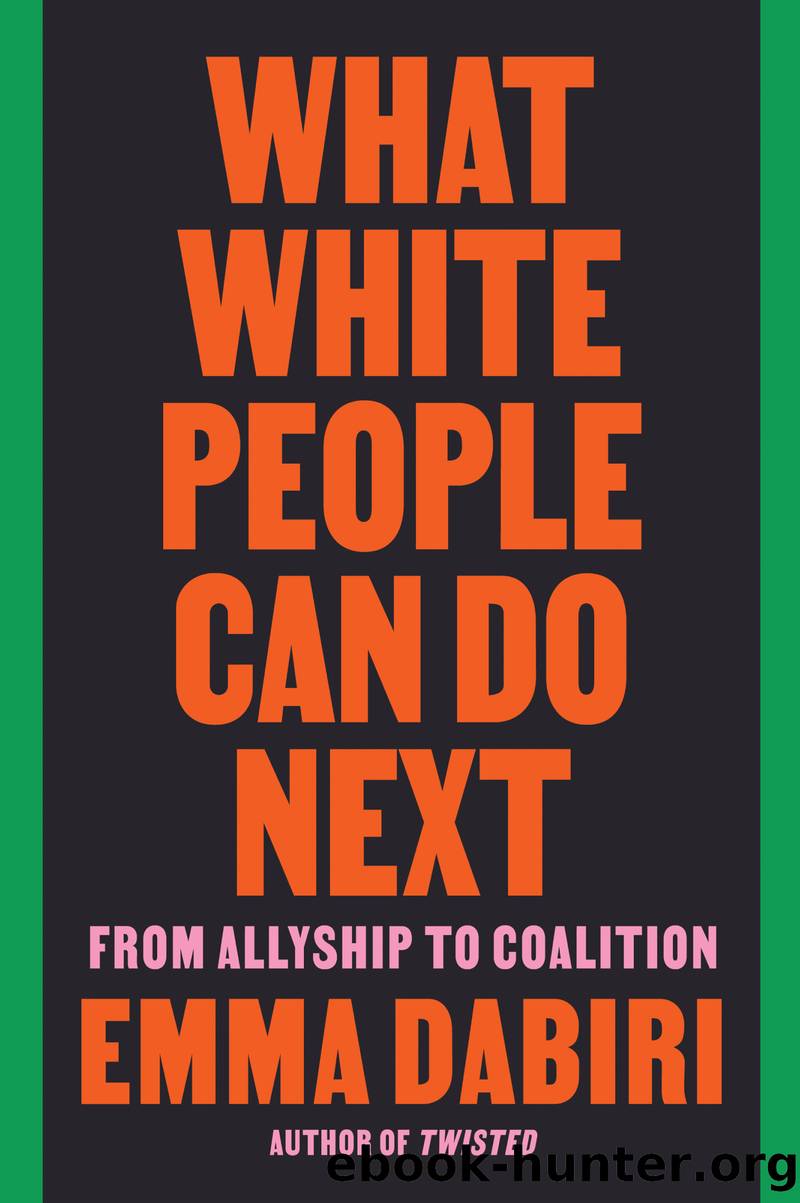
Author:Emma Dabiri
Language: eng
Format: epub
Publisher: Harper Perennial
Published: 2021-04-28T00:00:00+00:00
Meanwhile, the UK, with characteristic sleight of hand, generally outsourced its abuse of black people. Nonetheless, the exploitation of black people and the investment in the belief in white superiority would become an enduring cornerstone of both the economy of Britain and its identity. English superiority over the subjugated and the colonized was the ideological underpinning of the empire. The flow of wealth into the UK from the transatlantic slave trade was a crucial part of the industrial revolution, facilitating the development of industry, building the grandeur of many of the countryâs citiesâplaces like Bath, Bristol, and Liverpoolâand creating the framework for the modern banking system. It also laid the groundwork for colonialism. Those parts of Africa that had been looted for human bodies became the territories that Europeans colonized, once colonialismâthe extraction of resources and the opening of new markets, that ongoing and relentless pursuit of capitalismâproved more profitable than the trade in slaves. All of this allowed Britain to consolidate more wealth and power.
I think itâs safe to say that any antiracist or allyship initiative that disregards the capitalist imperatives (not to mention the deep psychological attachments that fuel âwhitenessâ), and that imagines that all of this can be undone by missives about âgiving up your privilege,â is highly unlikely to enjoy success.
It is crucial to connect the dots between the origins of global capitalism, colonialism, and the invention of race. Doing so highlights the fictitious nature of race, as well as revealing the motivations and incentives behind its creation and upkeep. Boots Riley, the communist filmmaker, discusses the movement from workplace organizingâa real and direct threat to capital (recall it was the threat posed by unions of laborers, enslaved and indentured, that inspired the creation of âraceâ in the first instance in places like colonial Barbados and Virginia)âto student organizing, which in the second half of the twentieth century came to shape concepts of revolution and societal change. Consider the difference between a labor strike and a student strike: one threatens capital, the other threatens little. Riley notes that, with the coming to prominence of the latter model, demonstrations become the be-all and end-all, people being out in the street and creating a spectacle become all important, and the media is seen as key. Yet, he argues, this is all largely symbolic. When you subtract organizing around the exploitation of labor, what is it that you are actually fighting for? The goal becomes more and more amorphous.
Download
This site does not store any files on its server. We only index and link to content provided by other sites. Please contact the content providers to delete copyright contents if any and email us, we'll remove relevant links or contents immediately.
| Anthropology | Archaeology |
| Philosophy | Politics & Government |
| Social Sciences | Sociology |
| Women's Studies |
Born to Run: by Christopher McDougall(7127)
The Leavers by Lisa Ko(6948)
iGen by Jean M. Twenge(5416)
Sapiens by Yuval Noah Harari(5372)
Spare by Prince Harry The Duke of Sussex(5197)
The Kite Runner by Khaled Hosseini(5180)
Machine Learning at Scale with H2O by Gregory Keys | David Whiting(4313)
Bullshit Jobs by David Graeber(4190)
Never by Ken Follett(3957)
Goodbye Paradise(3810)
Livewired by David Eagleman(3775)
Fairy Tale by Stephen King(3399)
A Dictionary of Sociology by Unknown(3085)
Harry Potter 4 - Harry Potter and The Goblet of Fire by J.K.Rowling(3074)
The Social Psychology of Inequality by Unknown(3031)
The Club by A.L. Brooks(2925)
Will by Will Smith(2920)
0041152001443424520 .pdf by Unknown(2846)
People of the Earth: An Introduction to World Prehistory by Dr. Brian Fagan & Nadia Durrani(2738)
